New Zealand Mintoffers new specialsilver coinfor love. It has a colorful picture made from 1 troy ounce of silver with the highest sample 999/1000. The coin is 40.7 millimeters in diameter, but its circulation is 20 000br. Sold for 50 euro in a luxury box in the form of a heart decorated with crystals Swarovski.
The coin is dedicated to the celebration of love - Valentine's Day, it could we celebrate love on any other occasion - engagement, wedding or wedding anniversary.
Vancouver 2010 Winter Games commemorative coin collection
Vancouver Coins
2010 Australian Gold Nugget Bullion Coins Art and coins come together in the launch of a series of commemorative coins for the 2010 Winter Games.Beginning in February and spanning the period up until Games time, the Royal Canadian Mint will unveil an extensive Olympic and Paralympic-related coin collection. With expressive designs created by Canadian artists, these coins offer an opportunity to relive the Games for years to come. The first modern Olympic-themed coins were struck to commemorate the 1952 Olympic Summer Games
in Helsinki, Finland. Since that time, coins have been produced by the mints of the Games host countries and are an integral part of Olympic culture, history and art.
Over the next three years, 17 coins will be put into circulation encompassing the most extensive Olympic Games circulation coin program ever undertaken by a Mint: from two commemorative Lucky Loonies to 25-cent winter sport-themed coins to a unique series offering Canadians the opportunity to vote on the athletes featured in its design.
“Taking into account the subject and the sport as well as who the audience is, is integral to the designing of coins,” says commemorative coin designer Steve Hepburn of Richmond, BC. “It’s important to convey a sense of what makes that sport special or different from others, and to make it visually appealing while remaining true to the sport and its intricacies.”
Numismatic, or collector coins, are detailed works of art worth far more than their face value and are sought by collectors as commemorative treasures and gifts.
The most expensive and heavy gold coin in the world
“The audience for collector coins is more specific than that for circulation coins,” says Hepburn. “When designing collector coins, there is more artistic freedom and room to be less conventional.”
Included in the limited mintage collection are sterling silver holographic coins, premium gold coins, and pure gold one-kilogram coins sure to satisfy the most ardent collector.2010 Gold Sovereigns - St. George
When designing collector coins Hepburn says “size and readability is a challenge. I worked on designs many times larger than the final product to ensure clean, crisp lines with good proportions. It’s very important to remove unnecessary details and information to make a strong-reading design at its final size.”
One of the design challenges Hepburn says is, “What looks good at 8 feet across may be a jumbled, unrecognizable mess when reduced to one inch. It’s important to involve the viewer when designing coins and to make them as interesting as possible by using perspective, angles and foreshortening.”
“I love sports,” says Hepburn. “When the Mint called, I was thrilled to be part of the project. I consider myself quite patriotic so the Olympic Games carry great importance to me. They’re always exciting and with them being in my backyard in 2010, it’ll be a year to remember. Go Canada, Go!”
Canadians can purchase the commemorative coins through theRoyal Canadian Mint’s website. Circulation coins are available at RBC Financial Group and participating Petro-Canada locations. Canadians can also look for these coins in their change – the first coin, curling, will begin circulating on February 23. 2010 Australian Gold Nugget Bullion
Santa Claus has been a centerpiece of Christmas fantasies for countless children everywhere, and a symbol of giving for family and friends every holiday season.
This silver proof coin commemorates Santa and is minted in 1 troy ounce of .999 fine silver, with selective plating in24-karat gold. The obverse features the jolly old likeness of Santa himself, along with the words, "Christmas 2009." The reverse has the text "Season's Greetings" with space available for engraving. The coin is enclosed in a lucite capsule, and comes in a museum quality leatherette presentation box with a certificate of authenticity.
Santa Christmas 2009 Silver
Santa Claus has been a centerpiece of Christmas fantasies for countless children everywhere, and a symbol of giving for family and friends every holiday season.
This silver proof coin commemorates Santa and is minted in 1 troy ounce of .999 fine silver. The obverse features the jolly old likeness of Santa himself, along with the words, "Christmas 2009." The reverse has the text "Season's Greetings" with space available for engraving. The coin is enclosed in a lucite capsule, and comes in a museum quality leatherette presentation box with a certificate of authenticity.
2010 Calendar Medal and Lucky Token from Austrian Mint
The Austrian Mint has produced 2010 Calendar Medals and Lucky Tokens in continuation of the ongoing series. These new issues are a great way to celebrate 2010 and bring good fortune for the new year!
2010 Calendar Medal and Lucky Token from Austrian Mint
The 2010 Calendar Medal honors the year's regent Apollo, the sun god. Designed and engraved by theMint’s Chief Engraver Thomas Pesedorfer, the medal depicts the mighty Apollo also know as Helios inGreek mythology. Apollo's personification by the sun is highlighted in the rays of light surrounding him. He points to the sun and the words, "Jahr der Sonne", or "Year of the Sun", appear around the upper left edge of the medal. Apollo masterfully controls his four winged stallions with one hand as they pull his chariot through the sky.
In the background the mighty lion is represented, which is the ascendant sign to Leo. The sign that is present at the time of birth governs our personality, and appearance. The hard working, loyal, and maybe somewhat conservative Leo’s will shine in 2010. Those born under the sign of Leo will find the year 2010 particularly meaningful.
On the other side of the medal all the Sundays are depicted as rays of sunlight emanating from the central figure underlining the bright year that 2010 represents.
The calendar medal has been an Austrian tradition since the 1930’s. Annually the medal changes to reflect a respective year’s regent and astrological ruler. The calendar medal is struck in 900 fine silver, weighs 26 grams and has a diameter of 40 millimetres.
2010 Lucky Token
The 2010 Lucky Token features our lucky friend, the chimney sweep takes flight, in a hot air balloon and travels the world. Warm soft breezes help him spread good luck through the four leaf clovers he sprinkles from above to all corners of the globe.
The other side of the token carries the traditional verse that loosely translated means: "Although I am small and round I will bring you luck all year round."
The lucky token has been an annual tradition since the 1930’s. People give them to their friends and family who will carry them for a year in their pockets and purses just for a wee bit of extra luck throughout the coming year.
Millard Fillmore Dollar Designer and Engraver: Don Everhart
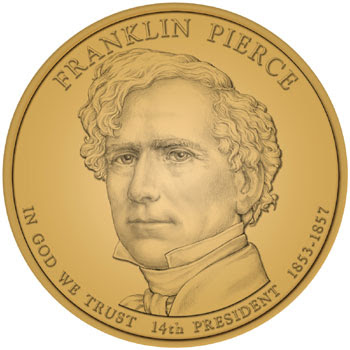
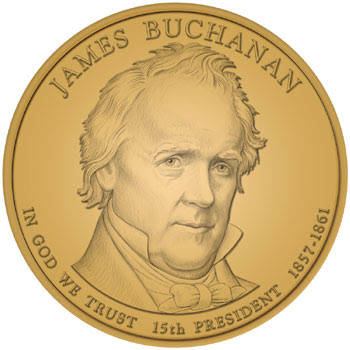
The United States Mint has released the designs that will be used for the upcoming 2010Presidential Dollars. Next year's coins will honor former Presidents Millard Fillmore, Franklin Pierce, James Buchanan, and Abraham Lincoln.
The obverse of each coin will feature a portrait of the President with inscriptions of the President's name, order of the Presidency, years served, and the motto "In God We Trust". The reverse of each coin will feature the rendition of the Statue of Liberty designed and sculpted by Don Everhart. Reverse inscriptions include "United States of America" and "$1". The date, mint mark, and motto "E Pluribus Unum" will appear on the edge of the coin with thirteen stars.
Franklin Pierce Dollar Designer: Susan Gamble Engraver: Charles Vickers
The highlight of next year's releases will be the Abraham Lincoln Presidential Dollar. Together with the newly designed 2010 Lincoln Cent, it will provide a nice capstone to the coins issued for Lincoln's Bicentennial. This year, the US Mint issued the 2009 Lincoln Cent with four different reverse designs and the 2009 Lincoln Commemorative Silver Dollar.
James Buchanan Dollar Desiger and Engraver: Phebe Hemphill
The US Mint line art images for each of next year's Presidential Dollars appear below, with the designers and engravers for each coin.
Abraham Lincoln Dollar Designer and Engraver: Don Everhart
2010 Australian Gold Nugget Bullion Coins The 2010 Australian Gold Nuggets were released on 1st October 2008. We have them in stock now for immediate delivery. Actually, we have now sold out of the one ounce version (it only took days), and are just awaiting our next order (3,000 pieces).
2010 One Ounce Nugget
We received our first delivery of the 2010 Australian gold nugget bullion coins on Wednesday 1st October 2008, we will have all five sizes from one ounce to twentieth ounce, with the larger sizes available to order. As with many new issues, they remain a premium price item for some time after issue. We usually incur extra costs in ensuring rapid availability, for pure bullion coins at the best prices, please see our other pages, but if you are looking for an interesting and unusual gift, then next year's new coins take some beating! We are accepting advance orders. Prices and Availability Sample prices based on gold at £600 per ounce. Please check current price and availability before ordering.
We received or first delivery of 2010 gold sovereigns in November 2009
Obverse of 2010 Uncirculated Sovereign
Sell-Out Prediction We can confidently predict a complete sell-out of the 2010 bullion sovereigns about June 2010, although the Royal Mint's retail sales department "The Royal Mint Coin Club", will probably retain a quantity to support its direct sales operation. It is therefore quite likely that these will start to sell at an extra premium price. In 2009 after our initial 5,000 pieces, we placed a second 5,000 piece order, and also upped our provisional order to 1,000 pieces per week. This would have meant that we alone would have taken about 50,000 of the 75,000 maximum mintage for the year. As it now stands, we are extremely unlikely to receive more than about 25,000 pieces, unless any other distributor fails to take up their allocation.
Reverse of 2010 Uncirculated Sovereign
Issue Limits - Uncirculated VersionFor 2005, the issue limit was only 75,000, the lowest bullion sovereignmintage for over 120 years, this has been the same since then. We expect the issue limit for 2010 to be similar.
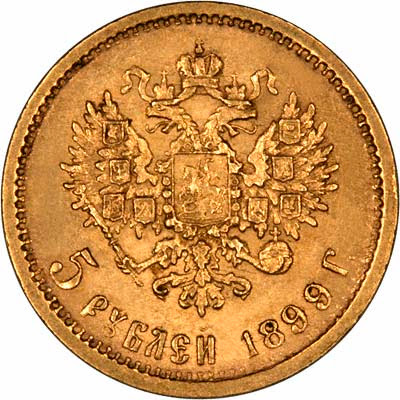
Russian Imperial Gold Coins In earlier days, Russia issued gold kopeks, ducats, poltinas, and novodels. In more recent times, most of the gold coins have been roubles or multiples of roubles. We give below the specifications of most of the more frequently encountered Imperial Russian gold coins, followed by a stock list of any we have for sale. Demand Outweighs Supply During the early months of 2007 we sold out of nearly all of our Russian Imperial gold coins, and have struggled to replace them. In June 2007 we were advised that gold coins from the Russian Empire were selling for over double the price of their intrinsic gold content. We believe that these are slightly crazy prices so we won't be buying any from the trade at these prices. If we do manage to source any at a reasonable price we will update this page accordingly.
The first platinum coins were issued in Russia in 1828, being 3 rouble pieces, followed by 5 roubles in 1829, 12 roubles in 1830. All these platinum issues continued until 1845, although the many of the 3 rouble dates are known to have been restruck later, presumably officially.After this, no other platinum coins were issued by any country until the 1970's.Russia (USSR) resumed the issue of platinum coins from 1977 to 1961, with a number of 150 rouble coins containing about a half ounce of platinum.The Moscow Olympics series, issued from 1977 to 1980 inclusive, has five designs, each issued in uncirculated and proof versions, and forms an interesting, affordable and attractive mini collection.The independent state of Russia has issued platinum coins from 1992, in denominations of 25 roubles containing a tenth ounce of platinum, 50 and 150 roubles containing a half ounce.
Reverse of Russian Platinum 150 Roubles for the 1980 Moscow Olympics
Platinum Bullion Coins Platinum coins are subject to VAT in the UK, so we have not until recently offered new platinum bullion coins, however, we can now obtain and supply them to special order. If demand is sufficiently high, we will start to carry them in stock.
In 2002 Russia began an annual program that each year commemorates some of their historical towns on bi-metallic 10 Ruble coins. The coins picture the city and its arms on one side and has the standard Russian 10 Ruble obverse on the other. The 2002 series was the first in the series. It honored the towns Kostroma, Starya Russa and Derbent. The 2003 series consists of 4 coins, commemorating the historic cities of Kasimov, Dorogobuzh, Murmom and Pskov. The 2004 series consists of 3 coins and honored the towns of Dmitgrov, Kemy and Riyazhsk. The 2005 series honors the towns of Mcensk, Kazan, Borovsk and Kaliningrad. The 2006 Series honored the towns of Torzhok, Kargopol and Belograd. The 2007 series pictured the towns of Gdov, Veliky Ustyug and Vologada. The 2008 Historic towns are Azov, Prioziorsk, Smolensk and Vladimir.
The 1933 double eagle (United States 20-dollar gold coin) currently holds the record for highest price paid at auction for a single U.S.coin when it was purchased for US$7.59 million. 445,500 specimens of this Saint-Gaudens Double Eagle were minted in 1933, the last year of production for the Double Eagle, but no specimens ever officially circulated and nearly all were melted down, due to the discontinuance of the domesticgoldstandard in 1933.
In an attempt to end the 1930s general bank crisis, U.S. president Franklin D. Roosevelt issued Executive Order 6102 in 1933 and the Gold Reserve Act in 1934, which outlawed the circulation and private possession of United States gold coins for general circulation, with an exemption for collector coins. This act declared that gold coins were no longer legal tender in the United States, and people had to turn in their gold coins for other forms of currency. The 1933 gold Double Eagles were struck after this executive order, but because they were no longer legal tender, most of the 1933 gold coins were melted down in late 1934 and some were destroyed in tests. Two of the $20 Double Eagles were presented by the United States Mint to the U.S. National Numismatic Collection, and they were recently on display in the "Money and Medals Hall" on the third floor of the National Museum of American History.
Gold Coins
These two coins should have been the only 1933 Double Eagle coins in existence. However, unbeknownst to the Mint, a number of the coins (20 have been recovered so far) were stolen, possibly by the U.S. Mint Cashier, George McCann. At least nine of these coins, which were illegal to possess, found their way via Philadelphia jeweler Israel Switt, into the hands of collectors.
Gold Coins
The coins circulated amongst collectors for several years before the Secret Service became aware of their existence. The matter came to the attention of Mint officials when an investigative reporter looked into the history of the coins and contacted the Mint as part of his research, as a result of which an official investigation was begun by the Secret Service in 1944. Seven of the coins were discovered and taken by federal agents within the first year of the investigation, with one coin remaining in public possession until 1952.
Golden CoinTwenty Dollars 1933
The Egyptian Double Eagle One of the missing Double Eagles was acquired by King Farouk of Egypt, who was a voracious collector of many things, including Imperial Fabergé eggs, antique aspirin bottles, paperweights, postage stamps - and coins, which he had a collection of over 8,500. In 1944 Farouk purchased a 1933 Double Eagle, and in strict adherence with the law, his ministers applied to the United States Treasury Department for an export license for the coin. Mistakenly, just days before the Mint theft was discovered, the license was granted. The Treasury Department attempted to work through diplomatic channels to request the return of the coin from Egypt, but World War II delayed their efforts for several years. In 1952 King Farouk was deposed in a coup d'etat, and many of his possessions were made available for public auction (run by Sotheby's) – including the Double Eagle coin. The United States Government requested the return of the coin, and the Egyptian government stated that it would comply with the request. However, at that time the coin disappeared and was not seen again in Egypt.
A Double Eagle surfaced again after over forty years of obscurity, when British coin dealer Stephen Fenton was arrested by US Secret Service agents during a sting operation at the Waldorf-Astoria Hotel in New York. Although he initially told investigators he bought the coin over the counter at his shop, he later changed his story. Under sworn testimony, he insisted the Double Eagle had come from the collection of King Farouk, though this could not be ascertained. Charges against Fenton were subsequently dropped, and he defended his ownership of the coin in court. The case was settled in 2001 when it was agreed that ownership of the Double Eagle would revert to the United States Government, and the coin could then legally be sold at auction. The United States Treasury issued a document to "issue and monetize" the coin, thereby making it a legal-tender gold coin in the United States.
When the coin was seized, it was transferred to a holding place believed to be safe: the Treasury vaults of the World Trade Center. When the court settlement was reached in July 2001, only three months before the Trade Center was destroyed, the coin was transferred to Fort Knox for safekeeping.
On July 30, 2002, the 1933 Double Eagle was sold to an anonymous bidder at a Sotheby's auction held in New York for $6.6 million, plus a 15-percent buyer's premium, and an additional $20 needed to “monetize” the face value of the coin so it would become legal currency, bringing the final sale price to $7,590,020.00, almost twice the previous record for a coin. Half the bid price was to be delivered to the United States Treasury, plus the $20 to monetize the coin, while Stephen Fenton was entitled to the other half. The auction took less than nine minutes.


 and a symbol of giving for family and friends every holiday season.