Millard Fillmore Dollar Designer and Engraver: Don Everhart
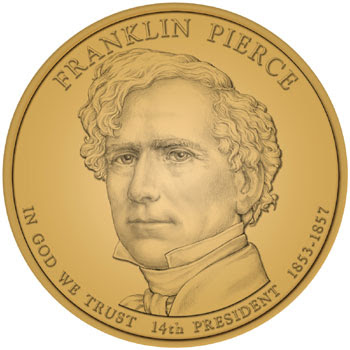
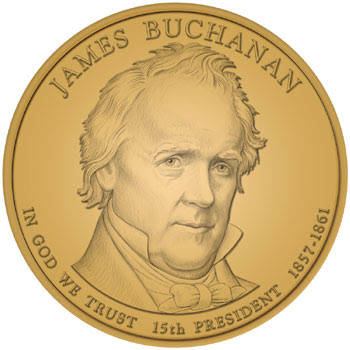
The United States Mint has released the designs that will be used for the upcoming 2010Presidential Dollars. Next year's coins will honor former Presidents Millard Fillmore, Franklin Pierce, James Buchanan, and Abraham Lincoln.
The obverse of each coin will feature a portrait of the President with inscriptions of the President's name, order of the Presidency, years served, and the motto "In God We Trust". The reverse of each coin will feature the rendition of the Statue of Liberty designed and sculpted by Don Everhart. Reverse inscriptions include "United States of America" and "$1". The date, mint mark, and motto "E Pluribus Unum" will appear on the edge of the coin with thirteen stars.
Franklin Pierce Dollar Designer: Susan Gamble Engraver: Charles Vickers
The highlight of next year's releases will be the Abraham Lincoln Presidential Dollar. Together with the newly designed 2010 Lincoln Cent, it will provide a nice capstone to the coins issued for Lincoln's Bicentennial. This year, the US Mint issued the 2009 Lincoln Cent with four different reverse designs and the 2009 Lincoln Commemorative Silver Dollar.
James Buchanan Dollar Desiger and Engraver: Phebe Hemphill
The US Mint line art images for each of next year's Presidential Dollars appear below, with the designers and engravers for each coin.
Abraham Lincoln Dollar Designer and Engraver: Don Everhart
The 1933 double eagle (United States 20-dollar gold coin) currently holds the record for highest price paid at auction for a single U.S.coin when it was purchased for US$7.59 million. 445,500 specimens of this Saint-Gaudens Double Eagle were minted in 1933, the last year of production for the Double Eagle, but no specimens ever officially circulated and nearly all were melted down, due to the discontinuance of the domesticgoldstandard in 1933.
In an attempt to end the 1930s general bank crisis, U.S. president Franklin D. Roosevelt issued Executive Order 6102 in 1933 and the Gold Reserve Act in 1934, which outlawed the circulation and private possession of United States gold coins for general circulation, with an exemption for collector coins. This act declared that gold coins were no longer legal tender in the United States, and people had to turn in their gold coins for other forms of currency. The 1933 gold Double Eagles were struck after this executive order, but because they were no longer legal tender, most of the 1933 gold coins were melted down in late 1934 and some were destroyed in tests. Two of the $20 Double Eagles were presented by the United States Mint to the U.S. National Numismatic Collection, and they were recently on display in the "Money and Medals Hall" on the third floor of the National Museum of American History.
Gold Coins
These two coins should have been the only 1933 Double Eagle coins in existence. However, unbeknownst to the Mint, a number of the coins (20 have been recovered so far) were stolen, possibly by the U.S. Mint Cashier, George McCann. At least nine of these coins, which were illegal to possess, found their way via Philadelphia jeweler Israel Switt, into the hands of collectors.
Gold Coins
The coins circulated amongst collectors for several years before the Secret Service became aware of their existence. The matter came to the attention of Mint officials when an investigative reporter looked into the history of the coins and contacted the Mint as part of his research, as a result of which an official investigation was begun by the Secret Service in 1944. Seven of the coins were discovered and taken by federal agents within the first year of the investigation, with one coin remaining in public possession until 1952.
Golden CoinTwenty Dollars 1933
The Egyptian Double Eagle One of the missing Double Eagles was acquired by King Farouk of Egypt, who was a voracious collector of many things, including Imperial Fabergé eggs, antique aspirin bottles, paperweights, postage stamps - and coins, which he had a collection of over 8,500. In 1944 Farouk purchased a 1933 Double Eagle, and in strict adherence with the law, his ministers applied to the United States Treasury Department for an export license for the coin. Mistakenly, just days before the Mint theft was discovered, the license was granted. The Treasury Department attempted to work through diplomatic channels to request the return of the coin from Egypt, but World War II delayed their efforts for several years. In 1952 King Farouk was deposed in a coup d'etat, and many of his possessions were made available for public auction (run by Sotheby's) – including the Double Eagle coin. The United States Government requested the return of the coin, and the Egyptian government stated that it would comply with the request. However, at that time the coin disappeared and was not seen again in Egypt.
A Double Eagle surfaced again after over forty years of obscurity, when British coin dealer Stephen Fenton was arrested by US Secret Service agents during a sting operation at the Waldorf-Astoria Hotel in New York. Although he initially told investigators he bought the coin over the counter at his shop, he later changed his story. Under sworn testimony, he insisted the Double Eagle had come from the collection of King Farouk, though this could not be ascertained. Charges against Fenton were subsequently dropped, and he defended his ownership of the coin in court. The case was settled in 2001 when it was agreed that ownership of the Double Eagle would revert to the United States Government, and the coin could then legally be sold at auction. The United States Treasury issued a document to "issue and monetize" the coin, thereby making it a legal-tender gold coin in the United States.
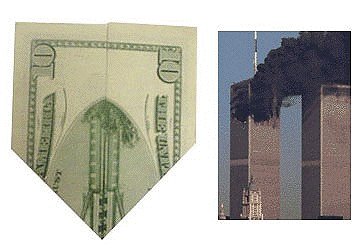
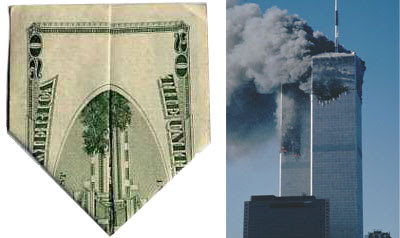
When the coin was seized, it was transferred to a holding place believed to be safe: the Treasury vaults of the World Trade Center. When the court settlement was reached in July 2001, only three months before the Trade Center was destroyed, the coin was transferred to Fort Knox for safekeeping.
On July 30, 2002, the 1933 Double Eagle was sold to an anonymous bidder at a Sotheby's auction held in New York for $6.6 million, plus a 15-percent buyer's premium, and an additional $20 needed to “monetize” the face value of the coin so it would become legal currency, bringing the final sale price to $7,590,020.00, almost twice the previous record for a coin. Half the bid price was to be delivered to the United States Treasury, plus the $20 to monetize the coin, while Stephen Fenton was entitled to the other half. The auction took less than nine minutes.
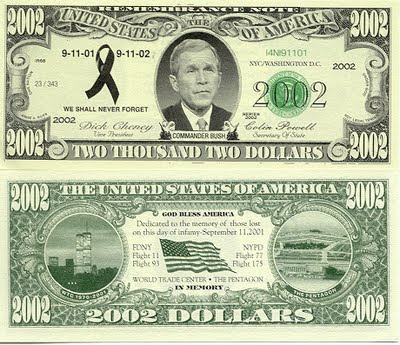
Usually the price of precious American dollars is at least double to that which is marked by its corners, especially the smaller denominations. Among the most common, but only among connoisseurs are banknotes of $ 2. Very expensive and metallicone dollar, but it no one sells it, as it is most rare in Bulgaria by U.S. money. Haggle about it is times more than its fair tsena. Quite more expensive are other 100-dollar bills, but with red or blue print on them. Their design is quite different from the usual $ 100.
1922 Feed The valuable dollars
Blue print paper money are the United States, which have the highest market price, as they were printed in 1922 and remained in extremely limited quantities worldwide. The number of hundred-dollar notes that are in red print are in greater quantity than printed in 1922, but because the year of their release into circulation is 1966. Profitability of these rare notes, however, may exceed 100 - 150%, but this depends on the condition of the banknote - whether pozahabena or maintained, you are missing parts or is it all over with spots or is it pure.
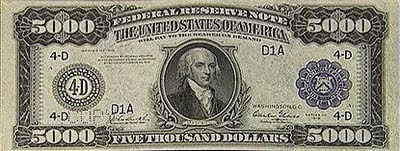
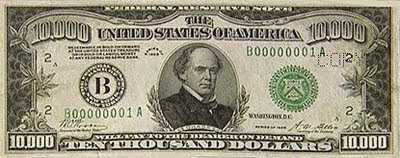
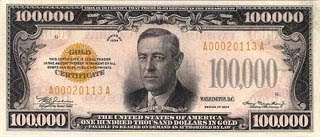
Fewer are the people who have not seen banknote- 1, 5, 10, 20, 50, or $ 100. But I do have units able to glimpse, let alone to maintain their hands in some of the most rare and valuable specimens of American money from$ 500, $ 1,000, $ 5,000, $ 10,000, $ 100,000 and $ 1000,000.
500 DOLLARS
1000 DOLLARS
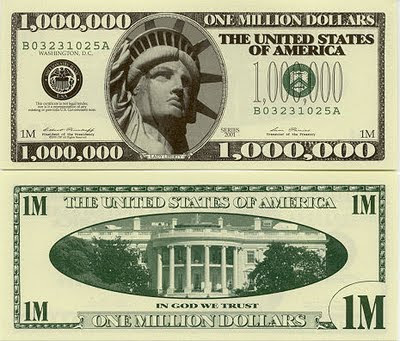
5000 DOLLARS10000 DOLLARS100000 DOLLARS ONE MILLION DOLLARS
The plan the administration of George Bush is to put passive RFID chip in a fixed rate one flat rate coins. Such chips are used in supermarkets to indicate goods outcome. Alert of them can be traced to three off m.Devices detection will be placed in machines to purchase food and drinks, to verify how many people will use coins with face value of one dollar.
COINS
ONE DOLLAR
The Treasury seeks to promote greater nominal value of coins to save the cost of printing paper 6.5 billion dollars annually, which are in circulation on average 18 months.U.S. government will experiment with new technology to see if it is also suitable for larger values.